 Frickel
Deutsche Fassung dieses Beitrags lesen
Motion sensors vs. presence sensors – who sees me when I sit still?
 By Norbert Hengsteler
PIR or mmWave radar? What the difference is, which devices are worth it in 2026, whether the cheap import shops still pay off, and why your lamps may soon notice all by themselves that someone is in the room.
Anyone who automates lighting in a smart home knows the moment: you're on the toilet, at your desk or on the sofa, reading, barely moving – and bang, the light goes out. So you wave your arms around until it comes back on.
The culprit isn't a bad sensor, it's the wrong principle. This post is about the difference between motion sensors and presence sensors, the devices worth buying in 2026, the question of the cheap import shops, and where the whole thing is heading.
As of: October 2026. The market moves fast, prices are ballpark figures.
The difference in one sentence
A motion sensor detects that someone is moving. A presence sensor detects that someone is there.
Motion sensors (PIR)
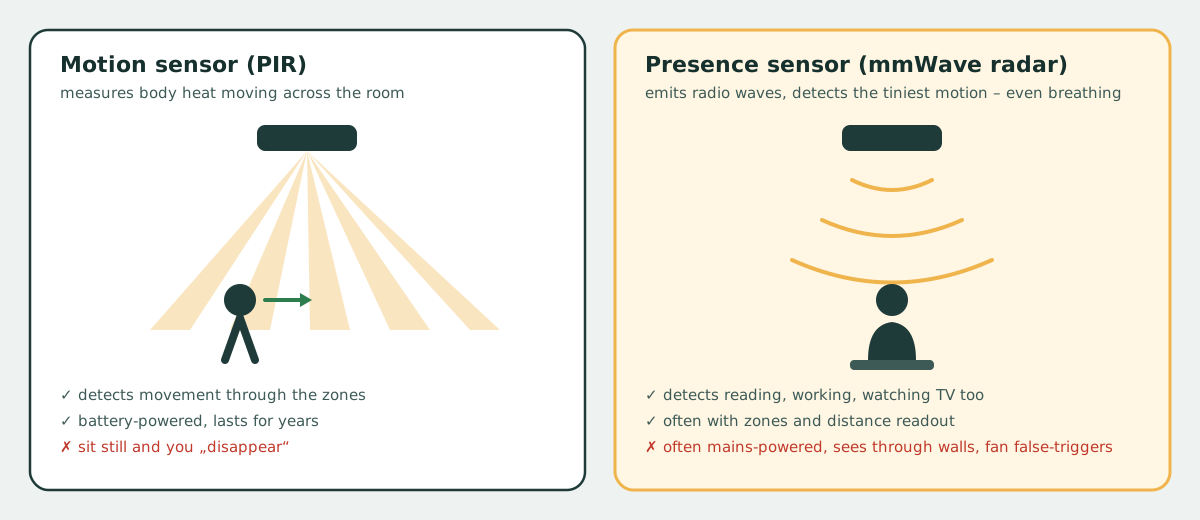
Classic motion sensors use a passive infrared sensor (PIR). They measure heat radiation. A lens splits the room into zones. When a warm surface – a person – moves from one zone into the next, the sensor fires.
- Pros: cheap, very low power and therefore years on a battery, robust, hardly any false alarms
- Con: whoever sits still doesn't exist as far as the sensor is concerned. Once the timeout runs out, the light goes off.
For the hallway, stairwell, storage room and driveway, a PIR sensor is still the right choice. You're moving around there anyway.
Presence sensors (mmWave radar)
Presence sensors emit their own radio waves in the millimetre-wave range, typically at 24 or 60 GHz, and evaluate the reflections. That lets them detect the tiniest movements – on good devices even the rise and fall of your chest as you breathe.
- Pros: they detect people even while reading, working or watching TV. Many measure distance, some track several people and split the room into zones.
- Cons: they need more power and therefore often a mains supply. They see through thin walls, react to fans, curtains in a draught or pets, and need a bit of tuning.
The best of both worlds
Many current devices combine the two: PIR for the fast reaction when you enter the room, radar for holding presence. That's also the recipe I recommend: light on by motion, light off only once the radar no longer sees anyone.
What for which room?
| Room | Recommendation | Why |
|---|---|---|
| Hallway, stairs, storage | PIR | you're moving, battery is enough |
| Bathroom, toilet | Presence | sitting still shouldn't mean darkness |
| Office, study | Presence | hours at the desk |
| Living room | Presence with zones | sofa, dining table, reading corner kept apart |
| Kitchen | Combination | on quickly, reliably stays on |
| Outdoors | PIR (outdoor-rated) | radar reacts to trees, rain, cars |
The players on the market
An overview of devices that have a good reputation in the Home Assistant community in 2026. No claim to completeness.
| Device | Radio | Power | Highlight |
|---|---|---|---|
| Aqara FP300 | Thread (Matter) or Zigbee | Battery | radar, PIR, light, temperature and humidity in one. Around €50 |
| Aqara FP2 | Wi-Fi | Mains | 60 GHz, up to 30 zones, multiple people |
| Meross MS605 | Thread (Matter) | Battery | waterproof, good for the bathroom |
| SwitchBot Presence Sensor | Bluetooth | Battery | cheap, needs a hub or Bluetooth proxy |
| Sonoff SNZB-06P | Zigbee | Mains (USB-C) | value-for-money tip, around $15 |
| Apollo MSR-2 / R PRO-1 | Wi-Fi, some LAN/PoE | Mains | ESPHome, very flexible, multiple zones |
| Everything Presence One / Lite | Wi-Fi | Mains | ESPHome, popular in the community |
| DIY: ESP32 + LD2410 / LD2450 | Wi-Fi (ESPHome) | Mains | a few euros, for tinkerers |
Two observations:
- Battery-powered presence sensors are the real novelty. For a long time radar meant a wall socket. Devices like the FP300 and MS605 cleverly switch the radar on only when needed and, according to the makers, last years on a battery. It doesn't come entirely without compromise: user reports mention the occasional presence dropout, which can be eased with a longer hold time.
- ESPHome devices are the Swiss army knife. If you like tuning, you get the most options here: sensitivity per distance range, zones, multiple people. In return you need Wi-Fi and a mains supply.
Is the cheap import shop worth it?
On AliExpress and similar platforms you'll find presence sensors from a few euros, mostly as Tuya devices with Zigbee. Tempting. But:
What speaks against the quick buy
- Same name, different electronics. Under the same product name you often find different firmware versions and sometimes even different radar chips. In Zigbee2MQTT you spot it by the model ID (e.g.
_TZE204_…). What one buyer loves can be a different device on the next order. - A Zigbee network under constant stress. Many cheap Tuya radar sensors send their readings every second. That can noticeably slow a Zigbee network down, including delayed switching commands for every other device. On some models this can't be fixed in the settings.
- Mislabelled goods. There are "radar" sensors that are really just two PIR sensors with a light sensor.
- Warranty and returns are tedious to practically non-existent.
- It's getting pricier. Since July 2026 the EU levies a flat €3 customs charge per type of goods in the parcel on small consignments under €150 from non-EU countries. Import VAT has applied for years anyway. The price advantage on a single sensor shrinks noticeably.
When it still makes sense
- You buy a specific model whose model ID you've checked beforehand in the Zigbee2MQTT (or ZHA) device database, and there are good user reports for it.
- You build it yourself: radar modules like the LD2410 or LD2450 cost a few euros in the import shop and are quickly wired up with an ESP32 and ESPHome. Here the import shop is unbeatable.
- Brand makers like Sonoff or Aqara sometimes sell cheaper there. But the same devices are often available in EU shops and from local dealers too, with a warranty.
My take: I'd no longer buy finished no-name presence sensors blind from the import shop. For DIY parts yes, for brand devices only if the price difference after customs and shipping is genuinely large.
Practical tips for presence sensors
- Mounting is everything. Radar "sees" in a cone. A sensor in the corner at head height, aimed at the area where you sit, works better than one in the middle of the ceiling above the doorway.
- Limit the range. Almost all devices let you set the maximum distance. That stops the sensor looking through the wall into the next room.
- Avoid sources of interference. Ceiling fans, curtains in front of a tilted window, plants in a draught, robot vacuums. Where possible, don't aim straight at them.
- Combine PIR and radar. Switch on via the fast motion detection, switch off only once the radar has seen no one for a while.
- Pick a generous hold time. Better 2 minutes than 10 seconds. Short dropouts get bridged that way.
Where is this heading?
Matter and Thread
With devices like the Aqara FP300 and the Meross MS605, presence sensors are arriving in the Matter world. One device that works equally with Home Assistant, Apple Home, Google and co. is, for many, the way out of the vendor maze. Not all settings are available over Matter yet. Some things only work in the maker's app or in Zigbee mode.
Lamps are becoming sensors
The most exciting development: motion detection without a sensor. With "MotionAware", Philips Hue offers a feature that detects movement from changes in the Zigbee radio signals between the lamps. You need the Hue Bridge Pro and at least three suitable lamps per area. Through walls and with pets it isn't perfect either, but the direction is clear.
The same principle exists for Wi-Fi. With IEEE 802.11bf, Wi-Fi sensing has had its own standard since 2025: the router detects from changes in the radio waves whether someone is moving in the room. It'll be a while before that reaches devices broadly.
More data, more responsibility
Presence sensors keep getting more precise: they count people, tell zones apart and in part detect breathing, sleep or falls. That's handy, for example for elderly people living alone. But it also means a great deal about daily life in the house gets recorded. That's exactly why it pays to go for devices that work locally, without a cloud. Home Assistant with Zigbee, Thread or ESPHome is ideal for that.
Bottom line
- PIR for the hallway, stairs and anywhere you only pass through. Cheap, battery-powered, reliable.
- Presence sensors (radar) for the bathroom, office and living room. Where you sit still.
- A combination of both for the best result.
- Import shop for DIY parts yes, for finished sensors only with a checked model ID.
- The future belongs to Matter, battery-powered radar sensors and lamps that notice all by themselves that someone is there.
And the light on the toilet finally stays on.
Sources: SmartHomeScene – Best and Worst Presence Sensors for Home Assistant 2026 · Matter Alpha – Aqara FP300 Review · Philips Hue – MotionAware · EY – Flat customs charge on small parcels from 01/07/2026 · IEEE – 802.11bf WLAN Sensing
Related on Frickelfabrik (in German):
- Getting a stable Zigbee network: channel choice, router devices and sensors that flood the network
- Home Assistant on the Raspberry Pi 5: the tutorial with Docker, Zigbee2MQTT and backups
 Eine Kamera für draußen gesucht?
Comments
No comments yet. Be the first.
Leave a comment
Commenting needs a free account. You sign in with a link by email, no password.
Sign in to comment